

On an exhausting day, while I was napping to relieve my fatigue, I got a text from my friend,” Want to go on an educational tour to Khulna?” That text was like a breeze on a sunny day to me. Though I was delayed in replying, after several back-and-forth communications, I was lucky enough to be selected as one of 8 members of IAAS Bangladesh IUBAT to start the journey. On 24th June,2026, our journey began. At 10 pm, we boarded the bus to Bagerhat at the Abdullahpur bus counter in Uttara. Bala da, Shuvo bhai, Jannat apu, Rafat, Shimato, Tanvir, Shomrat, and I buckled up for Southern Bangladesh. The bus journey was very enjoyable for all of us. We were very excited and looking forward to the trip. What will we explore? What cuisine will we try, and so on. And I must say, as my first trip away from my family and staying the night away, I was ecstatic.
At 3.50 am, on 25th June, 2026, the bus dropped us in front of the Mausoleum of Khan Jahan Ali, the founder of Bagerhat. It was dark outside, and 8 University students were standing in the middle of the road, which gave us a little shiver. Only a small tea stall was open, but that too looked suspicious to us. Bala Da was worried as we, two young ladies, were traveling along. It was a little spooky until we spotted a pavilion near the road, where people were gathered to watch the FIFA World Cup match of Scotland vs Brazil on a big projector screen. Without delay, we went there and watched the full match. The excitement and joy of Brazil fans were really appreciable. The best moment was when Neymar Jr stepped onto the field; it brought tears to many fans. After half-time, Fajr Ajan was heard, and the darkness was fading away. We went to a nearby tea stall and had a cup of tea to refresh. It was a new experience with a new day and a new start.
We continued our journey. Went to Khan Jahan Ali’s Majar first. There at the entrance, an interesting encounter occurred. We were taking a group picture at the front when a shabby-looking, thin lady came to us and asked about our whereabouts. At first, we didn’t mind much and politely said we were from Dhaka.
Dhaka, where?- she asked
- From Uttara.
-All of you are from Uttara?
We noticed something was off about the lady; one local person was smiling at us and gestured to us that she was mentally unstable. So we played along and said
-No, all of us are from Mirpur.
-Oh! Mirpur?
-Yes, Mirpur 12, Road no 2, House no 3.
-I see, I was at Mohammadpur for 11 years.
She asked why we were taking a picture, and Shimanto replied that it was for ‘The New York Times’ publication. She was amazed.
Then she told Rafat that she seemed to know him but couldn’t remember. In reply, Shimanto added that his father is the new MP from Jatrabari. That’s why he might seem familiar (Which was totally a lie)
-Is that so? What is his name?
Shimanto and Rafat shared glances and replied, ‘Nasiruddin Mirza’
We could barely hold our laughter and moved from there.
Inside the mausoleum, there was beautiful architecture and a small lake known as ‘Khan Jahan Ali Dighi’. The scenic beauty by the water captivated us. A soft, cool morning breeze made us feel light and refreshed. We sat there for quite a while, nobody wanting to leave. But the journey must go on. We took some photos and were heading for the exit when someone approached Tanvir and brother Shuvo, advising them to each donate 5 KGs of sweets and a handsome amount of money so that it would help them get married soon to some noble lady. We contained our laughter inside and hit the road. Now it was our time for breakfast, and a few stalls had just started to open. We had our breakfast in a hotel near the main road and planned the whole day. After breakfast, we had tea while Rafat talked with an E-rickshaw driver. He agreed to take us to all the historical places of Bagerhat within the day, and we hopped in the E-rickshaw. The road trip was fun, and after a while, we arrived at the One-Domed Mosque, known as ‘Ranbijoypur Mosque,’ which is situated 1.7 km east of the Sixty-Domed Mosque. It has a beautiful structure and intricate design. In 1985, UNESCO enlisted it as one of the mosques of the ‘Historical Mosque City of Bagerhat’
Our next destination was Zinda Pir’s Tomb. The place wasn’t that big, but it still held some history. What we felt was that it was lacking attention; there were no signs of maintenance, though it was still being used for different purposes. There were some fruit trees, and we took some hog plums from the tree and went on.

The excitement and the anticipation we had were escalating with each endpoint. The experiences were beyond our expectations. All the brothers were making sure that we, Jannat Apu and I were comfortable and safe, which was really the reason I could enjoy every moment without worrying. The time was with us. As we started our journey early, we felt like the time was passing slowly. Soon, we reached the Six-Domed Mosque. It was being used by the local people. Which is why there were water taps placed for ablution. As we couldn’t find the chance and place to tidy up, we took the chance and cleaned our mouths and faces properly. We were fully refreshed and continued to move forward. We arrived at the Nine-Domed Mosque, located on the western bank of Thakur Dighi. It was recently extensively repaired. Prominent chain and bell terracotta motifs adorn three mihrabs. We took some pictures there and again continued.
It was a fun trip for us; we were singing, laughing, and learning all the way. We reached Bibi Beguni’s Mosque, located on Ghora Dighi’s bank, 700 meters away from the Sixty-Domed Mosque to the west. All the architectural design and motifs were quite similar to those of other archaeological mosques we’d seen so far.

A local man suggested that we visit another mosque nearby, though we were hesitant, we still went there. It took us 12 minutes on foot, zigzag unpaved road with a shallow canal running along both sides, long kolmi plants full of flowers making a nice border leading towards the mosque, named ‘Chunakhola Mosque’, Picturesquely located on an isolated low mound amidst an expanse of flat cultivated fields. Behind the mosque was a tiny grass field connected with 3 small ponds, 2 small date palm trees were standing distant, ducks were swimming in the water, and birds were chirping. The water was so clear that fish were visible, and a vast cultivation field started after the ponds. Cool breeze and soft sunlight were making us relaxed. We sat on the grass, stared afar, eyes following nature. Time stopped, and we were lost admiring the scenic beauty. None of us wants to leave, but we must go on. With anticipation of the new, we moved. That brief moment spent there was worth a thousand; if we could, we would have such a moment again someday.
Finally, we arrived at our most-awaited ‘Sixty-Domed Mosque’. We had to buy tickets to enter, 30 taka per ticket. Though Bala da tried to get some discount for us as students, the cashier said that discounts are only for primary to higher secondary students. We were amazed at how clean and well-maintained it was; there were small parks for kids, and we rested there on the swing for some moments, then the hog plum that we had taken earlier, peeled and cut into pieces, and ate together. They were tasty. After relaxation, we visited the mosque, which was huge and one of the biggest mosques in Bangladesh. Khan al-Azam Ulugh Khan Jahan, popularly known as Khan Jahan Ali, founded the mosque in the 15th century AD. Brick, lime, shurki, stone, and terracotta ornaments were used as building materials. The architecture had a Turkish influence.

It was 12.20 pm at that time, and the scorching sun was draining our energy; we were out of water and tired, so we rested under a raintree shade near the mosque. There were two raintrees, planted in 1913. Rafat went and bought water for us, and we went to the Dighi behind the mosque and had some water. We soaked our feet in the water, which washed away all our fatigue, sat on the stairs of the dighi, and enjoyed the breathtaking view; water lily plants with full blooms covered the whole edge of the dighi, and big raintrees, jackfruit trees, and others surrounded the place, providing shade. We sat there for longer, and it reminded us of the moment we sat behind the Chunakhola mosque. Finally, we hit the road again. While we were traveling in an e-rickshaw, we noticed that there were many flower trees and fruit trees alongside the road, especially the Jhumko Joba plant. Tanvir got me a huge cutting of the plant, which later Shomrat divided into adequate sizes and gave to me. Now I am looking forward to getting some new plants
Without delay, we reached ‘Kodla Moth’ or ‘Ajodha Moth’. It was 18.29m high from the surrounding ground, having 2.75m thick walls. Its attractive feature was profusely decorated brick ornaments. The intricate patterns indicate the precise artistic expertise and hard work of ancient times. It was one of the well-maintained architecture of Bagerhat.

Now it was time to go to Khulna by crossing the Rupsha River, so we hopped in the e-rickshaw and hit the road. We sang songs, chatting and laughing. As the Rupsha Ferry Ghat was far away, the journey took longer, and we were getting tired. I dozed off a few times, Jannat apu took a small nap, but the tension was with Shimanto and Tanvir, who were sitting beside the driver, and Bala da, who was dozing off at the side. Because if they fall asleep and fall, it will cause some injuries. By the blessing of the Almighty, we arrived at Rupsha Ghat. There, we decided to have our lunch and went to an amazing restaurant selling ‘Chuijhal Mutton’, a special cuisine of Bagerhat. We had it with rice, and it was really spicy and tasty. It was my first time trying it, and I loved it. Then we had Roshogolla and Channa from ‘Ghos’s Sweet Shop’, which just melted in our mouths- highly recommended.
After lunch, we boarded a ferry, crossed the Poshur River, and reached Khulna district. We went to the Khulna Museum first, looked into the ancient archaeology, and headed to Khulna University. It was such a beautiful campus, and there was a lotus pond near the cafeteria, which I personally liked very much. We were honored to meet Mahfujur Rahman, National Membership Officer of IAAS Bangladesh, and Labone Akter, Former National Head of the Control Board there. Coincidentally, we met one of our faculty members there. She was giving a tour to her uncle, who had come from Japan. We greeted them and parted ways. While we were chatting and snacking in the cafeteria, it started pouring heavily. After it calmed down a little, we headed to our respective accommodations. The boys stayed at the KAU boys’ hostel, and we, two ladies, were at a female student’s home. She was such a nice person, and her family treated us like their own family. Our arrangements were done on the 2nd floor in the guest room. The room was comfortable, and we went to bed early after dinner, as we had the main event to attend the next day. The whole day was hectic; there wasn’t a single boring moment. We were on the run and couldn’t rest properly, so it was our valuable sleeping time.

The main event day, 𝑵𝒂𝒕𝒖𝒓𝒆 𝑼𝒏𝒅𝒆𝒓 𝑷𝒓𝒆𝒔𝒔𝒖𝒓𝒆: 𝑬𝒄𝒐𝒕𝒐𝒖𝒓𝒊𝒔𝒎 & 𝑬𝒏𝒗𝒊𝒓𝒐𝒏𝒎𝒆𝒏𝒕𝒂𝒍 𝑹𝒆𝒔𝒑𝒐𝒏𝒔𝒊𝒃𝒊𝒍𝒊𝒕𝒚, organized by IAAS Bangladesh KAU, on 26th June 2026. We woke up at 5.15 am, got ready, and got on KAU’s bus at 7 am. On the bus, we united with our male members. We had breakfast on the bus and listened to the instructions very carefully. That day, we were lucky enough to have Jannatul Ferdawsi Miti, Head of the Control Board (HCB) of IAAS World, Leuven, Belgium, with us. She’s such a lovely and humble person that she makes everyone comfortable around her. We learned many things from her.

At 8.12 am, we reached Mongla port. We took two trawler boats to cross the Poshur River and reached the Karamjol, Shundarban. Before we boarded the boat, we were instructed to keep our phones, bags, and other belongings safe, as the monkeys of Karamjol snatch them. As soon as we got off the boat, we saw some monkeys coming near us. Though it was rare- as monkeys generally avoid people- they weren’t scared of us. We were waiting for the 2nd boat to arrive. Meanwhile, we were taking a group photo when a monkey came from behind and tried to snatch Shuvo Bhai’s money bag. His reflexes were fast the bag was saved. We saw many mother monkeys carrying their babies; it was a wholesome scene.

The second boat arrived, and we gathered together and were about to enter the Mangrove Forest when something happened. I was walking in the opposite direction to our group to call my friends who were at some distance. I spotted a monkey approaching from the side. I didn’t make eye contact but was sure it was going to launch at me, and it did. It jumped onto my sling bag, gripped it tightly to snatch it. I swung the bag, and it fell. It tried again, and I removed the bag from my shoulder and flung it so the monkey couldn’t grab it. When everyone started making noise, the monkey walked away and was told to stay in groups.
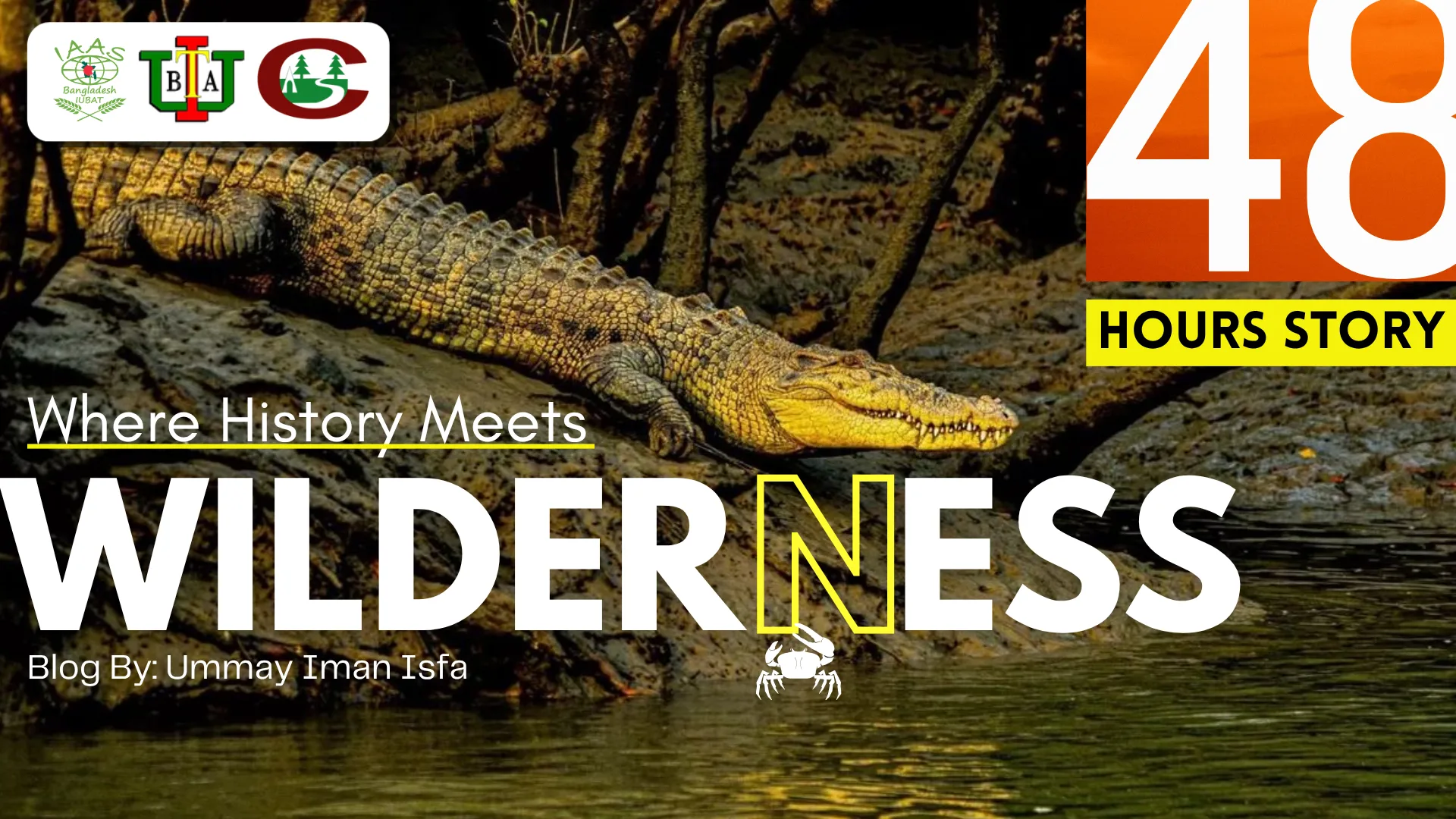
We entered the forest, saw many mangrove trees such as Shundori, Bain, Gewa, Golpata, etc. These trees have pneumatophores, known as breathing roots. We saw deer in the deer breeding center; some had beautiful antlers. A man was selling green leaves to the tourists to feed the deer. We also bought and fed the deer, touched them, and it was fun. Then we saw crocodiles in the breeding center, adult and baby crocodiles were kept separately. There was also a big, deep pond where two crocodiles were swimming, and we were informed that they were named Romeo and Juliet, and if you call them by their name they will come to the bank. We walked on the long, elevated wooden trail, popularly known as the "Monkey Trail," which winds deep through the dense canopy of Sundari and Gewa trees. This boardwalk allows tourists to experience the swampy forest floor, pneumatophores (breathing roots), and local wildlife—such as rhesus macaques, mudskippers, fiddler crabs, and diverse bird species—without disrupting the delicate terrain. It was breathtakingly beautiful, and the greenery was soothing to the eyes. We spotted some tiny crabs that had one big red claw, and they were fast.
Went to the top of the watch tower, captured the view in our minds, and returned. We were singing the whole way in the boat. The boat journey was another fun experience that elevated our mood. We went to the Bangladesh Environment and Development Society (BEDS), where we had our lunch, which was arranged by them, and took a seat in the conference room. There were two seminars, one done by the director of BEDS and another by Jannatul Ferdawsi Miti, Head of the Control Board (HCB) of IAAS World, and at the end of every session, there was an instant quiz where, out of three winners, Shomrat was one. It was a proud moment for us. Then came the award ceremony, where we, representatives of IAAS Bangladesh IUBAT, were honoured with a certificate, and Shomrat was awarded a beautiful Adenium plant.

We explored the BEDS campus. It was so beautiful that we had to admire the project they initiated in the southern region for the betterment of the coastal people and to protect the mangrove. The cottages they had there were beautiful and looked luxurious. Finally, the event came to an end with a tree plantation program. 10 Bain trees were planted, and I also planted one.
It was time to return home, and we were escorted to the bus counter by the organizers. Our bus departed at 11 pm, and we reached Dhaka at 5 am in the morning. Our two-day trip came to an end, but the memories will stay with us for a long time. On the first day, we walked through old mosques and historic buildings in Bagerhat, learning about the past. On the second day, we explored the wild and beautiful Sundarbans in Karamjol, seeing mangrove trees and wildlife up close. This journey taught us many things; we made many new friends and connections.
This trip showed us that Bangladesh has so much to offer—rich history on one side and amazing nature on the other. Whether you love learning about the past or exploring nature, this trip to Bagerhat and Sundarban has something special for everone.

About the author
Ummay Iman Isfa
General Member of IAAS Bangladesh IUBAT, Collage of Agricultural Sciences (CAS), IUBAT-International University of Business Agriculture and Technology, Dhaka, Bangladesh.
Related articles
Sep 01, 2026
Floating Markets in Bangladesh: Turning Waterways into Sustainable Rural Economics
Imagine setting out on a rainy-season morning and slowly leaving the familiar roads behind, only to find yourself surrou...
Aug 11, 2026
Bhawal’s Cry: From Sacred Forest to Dumping Ground?
I was born where the red earth of Gazipur meets the ancient silence of the Sal forest, and I grew up beneath the vast, s...
Jul 21, 2026
Srihatta: A Journey That Fed the Soul
Some trips are planned. Some trips are needed. This one was both. After a week of lectures, assignments and the particul...