
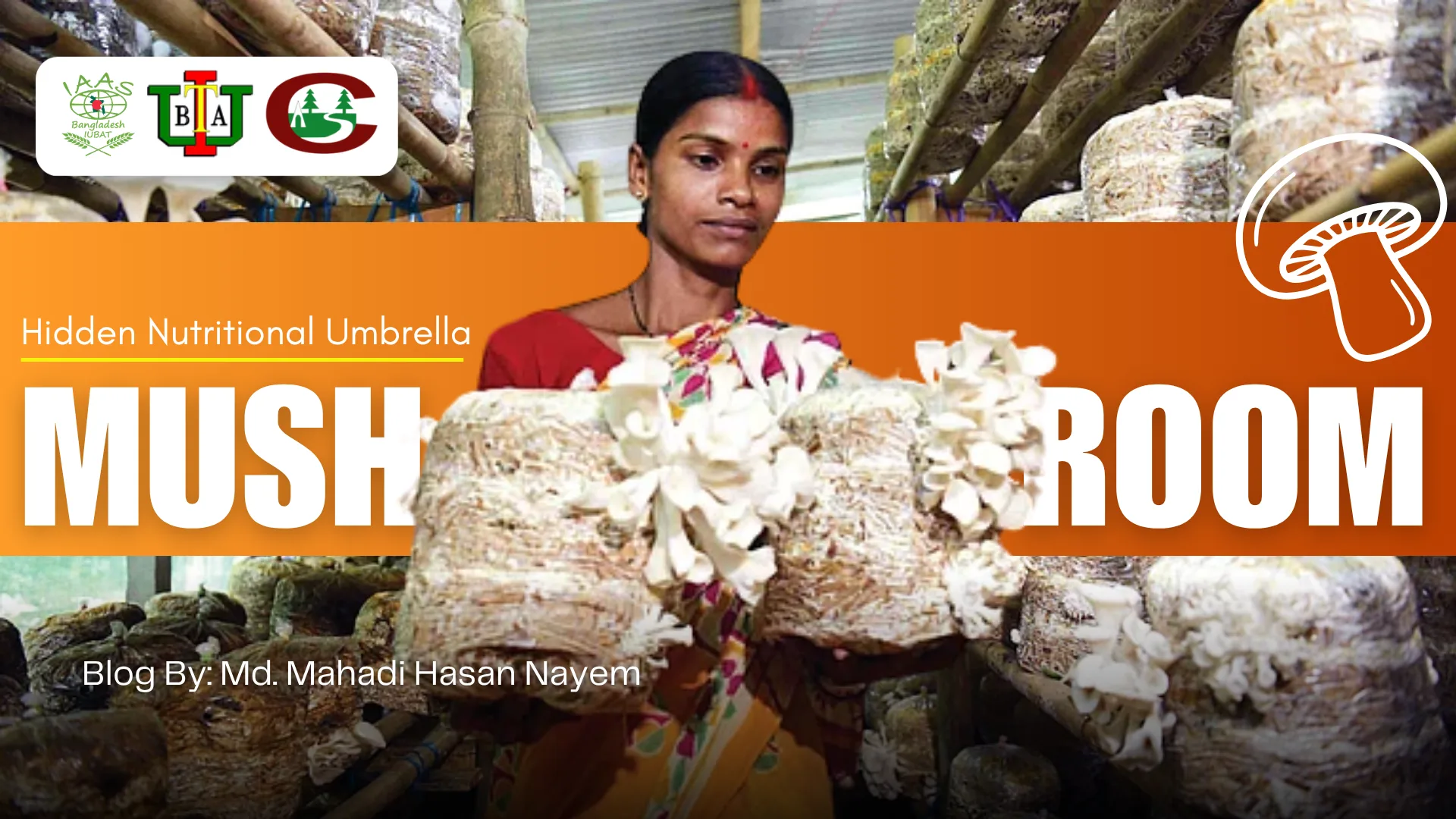
Sacrificing the cozy sleep of a rainy weekend morning, we set out for an educational visit to the National Mushroom Development Institute, organized by IAAS BANGLADESH IUBAT. Last Thursday (August 06, 2026), at 7:00 AM sharp, our journey began from the IUBAT campus.
Since we were a mixed group of students from different semesters, our thoughts were equally mixed! Some were probably thinking, "Are we really traveling this far just to see toadstools?" Others were wondering, "Is it a plant or an animal? Can you actually eat it?" And maybe a few were already dreaming, "How can someone become an entrepreneur through mushroom farming?"
Before those thoughts could even settle, we arrived at the National Mushroom Development Institute in Sobhanbagh, Savar at 8:10 AM.
As we were walking around and quenching our curiosity by exploring the surroundings, Ms. Mst. Alia Akhtar, Assistant Mushroom Development Officer, warmheartedly received us. She guided us to the auditorium, and shortly after, the Deputy Director, Dr. Md. Ferdous Ahmed, joined us. Seeing a vibrant team of 40 young students, Sir was genuinely delighted and exchanged warm greetings with us.
Then, he launched into the main seminar. He took us back in time to the very beginning—1980—when the journey of mushroom cultivation on the plains of Bangladesh began at Sobhanbagh, Savar, through the technical support of JICA (Japan International Cooperation Agency) by setting up a laboratory and initiating cultivation. Later, to spread mushroom culture and its nutritional message nationwide, a special government expansion project was launched in 2002. Following this momentum, under the Japan Debt Cancellation Fund (JDCF) from 2009 to 2013, the scope of research and infrastructure expanded exponentially. Finally, in July 2015, it transformed into a permanent national institution under the Ministry of Agriculture: the Mushroom Development Institute (MDI). Today, it serves as the central hub for producing high-quality spawn (seeds), preserving germplasms, and providing education and training to young entrepreneurs and farmers.
After wrapping up the institutional background, Sir shifted the discussion to mushrooms in the context of Bangladesh. While the global popularity and demand for mushrooms are soaring, many people in Bangladesh still dismiss them as mere "toadstools." Although its popularity is growing locally, it is far from where it should be considering its immense importance.
What amazed us the most was when Sir discussed mushrooms (fungi) through the lens of the Holy Quran and Hadith.
📖 Allah says in the Holy Quran:
❝And We shaded you with clouds and sent down to you manna and quails, [saying], 'Eat from the good things with which We have provided you.' And they wronged Us not - but they were wronging themselves.❞
(Surah Al-Baqarah, Ayah: 57)
📖In Sahih Hadith, the Prophet ﷺ said:
«الكمأة من المن وماؤها شفاء للعين»
(Truffles/Mushrooms are a part of Manna, and their water is a healing for the eyes.)
(Sahih Bukhari, Hadith No: 4478)
🔎 Here, “الكمأة” refers to a type of mushroom/truffle grown in the desert, and “المن” compares it to Manna (heavenly food) sent down by Allah.
Sir explained that mushrooms are neither plants nor animals—they belong to a completely separate kingdom: Fungi. A mushroom is the fleshy, spore-bearing fruiting body of a fungus. Unlike regular plants, mushrooms lack chlorophyll and cannot synthesize their own food using sunlight.
Looking around during this fascinating explanation, I noticed everyone had whipped out their notebooks! Like thirsty swallows waiting for rain, everyone was listening intently and taking notes. Although mushrooms thrive naturally in cold climates, successful cultivation in Bangladesh is completely doable by controlling the environment. All it requires is a humid, damp atmosphere, a room temperature between 25–30°C, and keeping them away from direct sunlight and harsh winds.
Globally, the most popular and cultivated mushroom is the Button Mushroom (costing around BDT 400–500/kg). In 2nd place is the Shiitake Mushroom (priced at nearly BDT 1500/kg due to its rich taste and demand). Holding 3rd place globally—but ranking #1 in Bangladesh—is the Oyster Mushroom (priced at BDT 400–500/kg fresh, and BDT 1400–2500/kg dried).
Depending on the season, different varieties thrive best. For instance, Oyster and Ear Mushrooms can be grown year-round. Warm-weather lovers include Milky and Reishi, while Button, Shiitake, and Maple Mushrooms perform best in winter. However, not all mushrooms are edible! Non-edible or wild mushrooms can often be identified by bad odors, a dark-colored volva at the root base (with the exception of straw mushrooms), color changes (especially turning red) when cut, or being extremely soft and fragile to the touch. Some non-edible species even secrete a milky white liquid when cut. Furthermore, all species under the Amanita Genus are poisonous. Therefore, one should never harvest or consume unknown wild mushrooms without expert knowledge. Consuming poisonous mushrooms can even lead to death.
When the discussion moved to nutritional value, our eyes widened in absolute shock! Mushrooms contain virtually every essential nutrient, with vitamins and minerals making up nearly 60% of their composition. The most mind-blowing fact? They contain Vitamin D—a vitamin typically synthesized directly from sunlight and one that urban populations severely lack today! If mushrooms are exposed to sunlight for 20–30 minutes before cooking, their Vitamin D content can increase 4 to 5 times! Besides Vitamin D, they are packed with vitamins B2, B3, B5, and B9. They also contain Selenium, a mineral that boosts antioxidant production. Mushrooms consist of about 30% protein, but unlike meat or fish, it is non-saturated. Carbohydrates make up only 4% of their energy contribution, which is ideal for health. They contain 35% Mannitol (compared to ~80% starch in rice). Excess starch converts to fat in our bodies and burdens the liver, making mushrooms an ideal healthy carb alternative. Additionally, they contain 6% healthy fats and dietary fiber, which is crucial for digestion.
Furthermore, mushrooms help combat Type-2 diabetes, lower LDL (bad cholesterol), support heart and liver health, and act as potent antivirals. Sir further added that mushrooms are like potatoes—they adapt seamlessly to almost any dish and can be cultivated almost anywhere. With minimal care, mushrooms can be grown easily, and they can be served in versatile, delicious ways such as mashed, fried, cooked with vegetables, added to salads, or made into crispy chops.
Summarizing these benefits, Sir famously stated:
❝Mushrooms are not toadstools; they are a true Nutritional Umbrella!❞
Learning about the vast benefits of this humble fungus ignited our curiosity: How are they actually produced? Before we could even ask, Sir flipped to the next slide:
Mushroom Cultivation Process:
Pure Culture ➡️ Master Mother ➡️ Mother Culture ➡️ Sub-Mother Culture ➡️ Spawn (Seed).
This is the cycle of producing mushroom spawn. However, for aspiring entrepreneurs, Sir recommended starting directly by purchasing ready-made spawn.
Finally, Sir highlighted their significance in Bangladesh. With a rapidly growing population and shrinking agricultural land, mushrooms offer a brilliant solution—they can be grown in a small corner of a room, in hanging baskets, or on vertical racks. Another fantastic aspect is that women can easily manage it at home. It requires minimal time, capital, and physical labor, yet offers high market value, making it a powerful tool for poverty alleviation. Therefore, to rapidly transform the wheels of Bangladesh's economy, widespread promotion, extension, and public awareness of mushrooms are vital. The more people learn about these incredible benefits, the higher the national demand and growth will soar.
Hearing all this wasn't enough; we were itching to see it with our own eyes! And that wish came true right after the seminar. The Assistant Mushroom Development Officer took us on a guided tour of the production rooms, cultivation chambers, and laboratories. We observed the seed-making process, raw materials, and specialized machinery firsthand.
Next, through Dr. Ferdous Sir's coordination, we visited the Horticulture Center right across the street. Horticulture Officer Kamrunnahar Milli Ma'am welcomed us warmly and unexpectedly gifted each of us a small cactus plant! There, we gained practical insights into various cactus species, propagation techniques for endangered native fruit trees, and fruit bagging methods—valuable knowledge that only agriculture students can truly appreciate.
By then, our lunch was ready, and after absorbing so much knowledge, we were all starving! The highlights of the meal were the delicious Mushroom Chops and Mushroom Thai Vegetables. My mouth still waters just writing about it! After enjoying a hearty lunch, the day concluded with closing remarks from Sir and the awarding of certificates to all participants.
Despite a day filled with light rain and physical fatigue, all our tiredness melted away in an instant. Such an enriching and beautiful visit effortlessly overwhelmed every bit of exhaustion! Last but certainly not least, a massive shoutout to our senior brothers and sisters who, despite being in their final semester internship, put in so much effort to gift us such an amazing seminar—we are deeply grateful to you all. Special thanks to IAAS BANGLADESH IUBAT and the National Mushroom Development Institute!

About the author
Md. Mahadi Hasan Nayem
General Member of IAAS Bangladesh IUBAT. Collage of agricultural Sciences, IUBAT-International University of Business Agriculture and Technology.
Related articles
Jul 23, 2026
Safeguarding Bangladesh's Blue Heritage: Protecting Mother Fish
The phrase "Maache-Bhaate Bangali" is widely recognized as a symbol of the Bengali identity. Literally meaning...
Jul 22, 2026
The Silent Killer in Our Wetleads
There are some places that never really leave us. No matter how far we travel or how busy life becomes, they continue to...
May 26, 2026
Why Agriculture Needs Young Minds?
About 1 billion people depends on Agriculture for their livelihood which means about 27 - 28 % people of total world pop...